What is a variable
A variable is an object that holds a single value of a specific type e.g., integer, date, or varying character string.
We typically use variables in the following cases:
- As a loop counter to count the number of times a loop is performed.
- To hold a value to be tested by a control-of-flow statement such as
WHILE. - To store the value returned by a stored procedure or a function
Declaring a variable
To declare a variable, you use the DECLARE statement. For example, the following statement declares a variable named @model_year:
| 1 | DECLARE @model_year SMALLINT; |
The DECLARE statement initializes a variable by assigning it a name and a data type. The variable name must start with the @ sign. In this example, the data type of the @model_year variable is SMALLINT.
By default, when a variable is declared, its value is set to NULL.
Between the variable name and data type, you can use the optional AS keyword as follows:
| 1 | DECLARE @model_year AS SMALLINT; |
To declare multiple variables, you separate variables by commas:
| 12 | DECLARE @model_year SMALLINT, @product_name VARCHAR(MAX); |
Assigning a value to a variable
To assign a value to a variable, you use the SET statement. For example, the following statement assigns 2018 to the @model_year variable:
| 1 | SET @model_year = 2018; |
Using variables in a query
The following SELECT statement uses the @model_year variable in the WHERE clause to find the products of a specific model year:
| 12345678910 | SELECT product_name, model_year, list_price FROM production.productsWHERE model_year = @model_yearORDER BY product_name; |
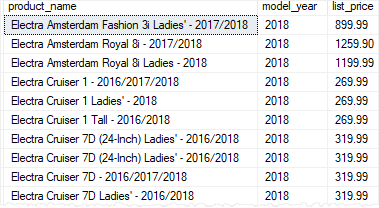
Now, you can put everything together and execute the following code block to get a list of products whose model year is 2018:
| 1234567891011121314 | DECLARE @model_year SMALLINT; SET @model_year = 2018; SELECT product_name, model_year, list_price FROM production.productsWHERE model_year = @model_yearORDER BY product_name; |
Note that to execute the code, you click the Execute button as shown in the following picture:
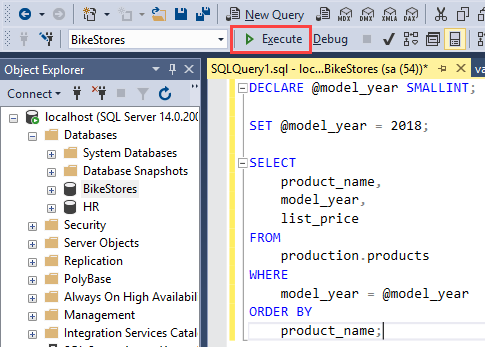
The following picture shows the output:
Storing query result in a variable
The following steps describe how to store the query result in a variable:
First, declare a variable named @product_count with the integer data type:
| 1 | DECLARE @product_count INT; |
Second, use the SET statement to assign the query’s result set to the variable:
| 123456 | SET @product_count = ( SELECT COUNT(*) FROM production.products ); |
Third, output the content of the @product_count variable:
| 1 | SELECT @product_count; |
Or you can use the PRINT statement to print out the content of a variable:
| 1 | PRINT @product_count; |
or
| 1 | PRINT ‘The number of products is ‘ + CAST(@product_count AS VARCHAR(MAX)); |
The output in the messages tab is as follows:
| 1 | The number of products is 204 |
To hide the number of rows affected messages, you use the following statement:
| 1 | SET NOCOUNT ON; |
Selecting a record into variables
The following steps illustrate how to declare two variables, assign a record to them, and output the contents of the variables:
First, declare variables that hold the product name and list price:
| 123 | DECLARE @product_name VARCHAR(MAX), @list_price DECIMAL(10,2); |
Second, assign the column names to the corresponding variables:
| 1234567 | SELECT @product_name = product_name, @list_price = list_priceFROM production.productsWHERE product_id = 100; |
Third, output the content of the variables:
| 123 | SELECT @product_name AS product_name, @list_price AS list_price; |

Accumulating values into a variable
The following stored procedure takes one parameter and returns a list of products as a string:
| 1234567891011121314151617181920 | CREATE PROC uspGetProductList( @model_year SMALLINT) AS BEGIN DECLARE @product_list VARCHAR(MAX); SET @product_list = ”; SELECT @product_list = @product_list + product_name + CHAR(10) FROM production.products WHERE model_year = @model_year ORDER BY product_name; PRINT @product_list;END; |
In this stored procedure:
- First, we declared a variable named
@product_listwith varying character string type and set its value to blank. - Second, we selected the product name list from the products table based on the input
@model_year. In the select list, we accumulated the product names to the@product_listvariable. Note that theCHAR(10)returns the line feed character. - Third, we used the
PRINTstatement to print out the product list.
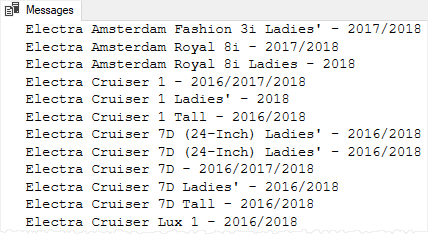
The following statement executes the uspGetProductList stored procedure:
| 1 | EXEC uspGetProductList 2018 |
The following picture shows the partial output:
In this tutorial, you have learned about variables including declaring variables, setting their values, and assigning value fields of a record to the variables.